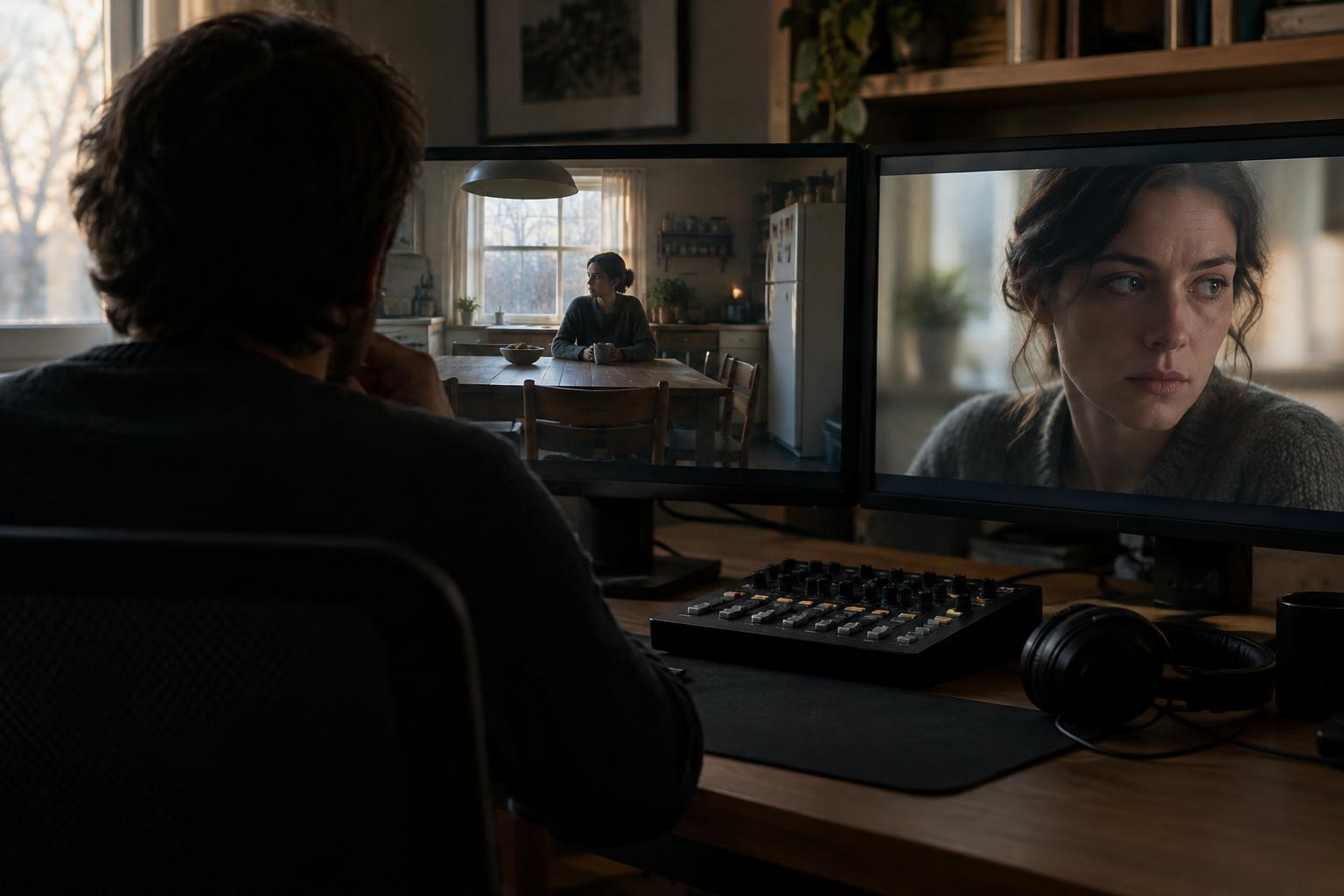
A reaction is a choice about attention
In a conversation scene, the camera does not have to follow whoever is speaking. Cutting to the listener asks the audience to watch someone receive the words instead. A small change in posture, a delayed answer or an expression held in check can become more important than the line itself. The edit determines whether that moment is visible, how long it lasts and what it appears to mean.
A useful first question is not “Do we have a reaction shot?” but “Whose experience matters at this point?” If the scene turns on the speaker finding the courage to confess, staying with the speaker may preserve that struggle. If the confession changes the listener’s understanding, a cut to the listener may make the turn clear without additional dialogue. Neither choice is automatically more dramatic; each gives the audience a different place to look for the story.
Choose the moment of the cut
The timing of a reaction shot can change its meaning. Cut to the listener before a decisive line, and the audience watches them anticipate what is coming. Cut on the line, and the words seem to land immediately. Wait until after the speaker finishes, and the pause may suggest that the listener needs time to process, resist or conceal a response. An editor can test these possibilities without changing a single word of dialogue.
Consider a character asking, “Did you tell them?” Showing the listener throughout the question might let a flicker of guilt answer it early. Remaining on the questioner keeps the audience uncertain until the reply or a later cut. The best placement depends on what the scene should disclose and when. Even a compelling performance need not be shown at its earliest opportunity.
Let duration do the work
Once the edit reaches the listener, the length of the shot matters as much as its placement. A brief look can confirm that a remark has registered. A longer hold can give the audience room to wonder whether the listener will speak, leave or do nothing. Hold too long without a meaningful change, however, and the shot may begin to feel like an instruction to search for significance that the scene cannot support.
It helps to watch for a specific progression rather than a fixed number of seconds: the listener hears, considers and decides what to reveal. That progression might be visible in the face, or it might emerge from stillness against an impatient speaker heard off-screen. When comparing versions of a scene, try ending the reaction just before the listener answers, then try carrying it through the first words of their reply. The difference can shift emphasis from private thought to public action.
Use sound to keep the other person present
A cut away from the speaker need not interrupt their presence. Keeping their dialogue over the listener’s image allows the audience to hear one character while studying another. Breath, hesitation and changes in vocal pace can also affect how the listener’s silence reads. Conversely, a stretch of quiet may make a small movement or averted gaze feel consequential.
Sound can bridge the cut so that the exchange feels continuous, but continuity is not the only goal. An editor might stay on the listener as the speaker moves off-screen, or allow the speaker’s next line to begin before returning to them. These choices can make the listener seem trapped in a conversation, free to ignore it or newly attentive. The sound track and the image should be considered together: a reaction that feels ambiguous in silence may become much more pointed beneath a particular line.
Balance clarity with discovery
Reaction shots help orient viewers within a group scene. They can establish who heard a remark, whose approval matters or which relationship has changed. But cutting to every person after every important line can flatten those distinctions. Selective coverage gives a reaction weight: the audience notices this listener because the edit has not treated every glance as equally revealing.
When assembling a scene, watch it once while following the speaker’s objective, then again while following the listener’s. Ask what the audience knows at each cut and whether that knowledge arrives at a useful moment. Check eyelines and screen direction so viewers can understand the exchange without having to reconstruct the room. Finally, try removing a reaction you like. If the scene gains tension or allows the audience to make its own inference, withholding it may be the stronger choice. A listener can shape a scene even when the edit leaves their face unseen.