What the invisible line does
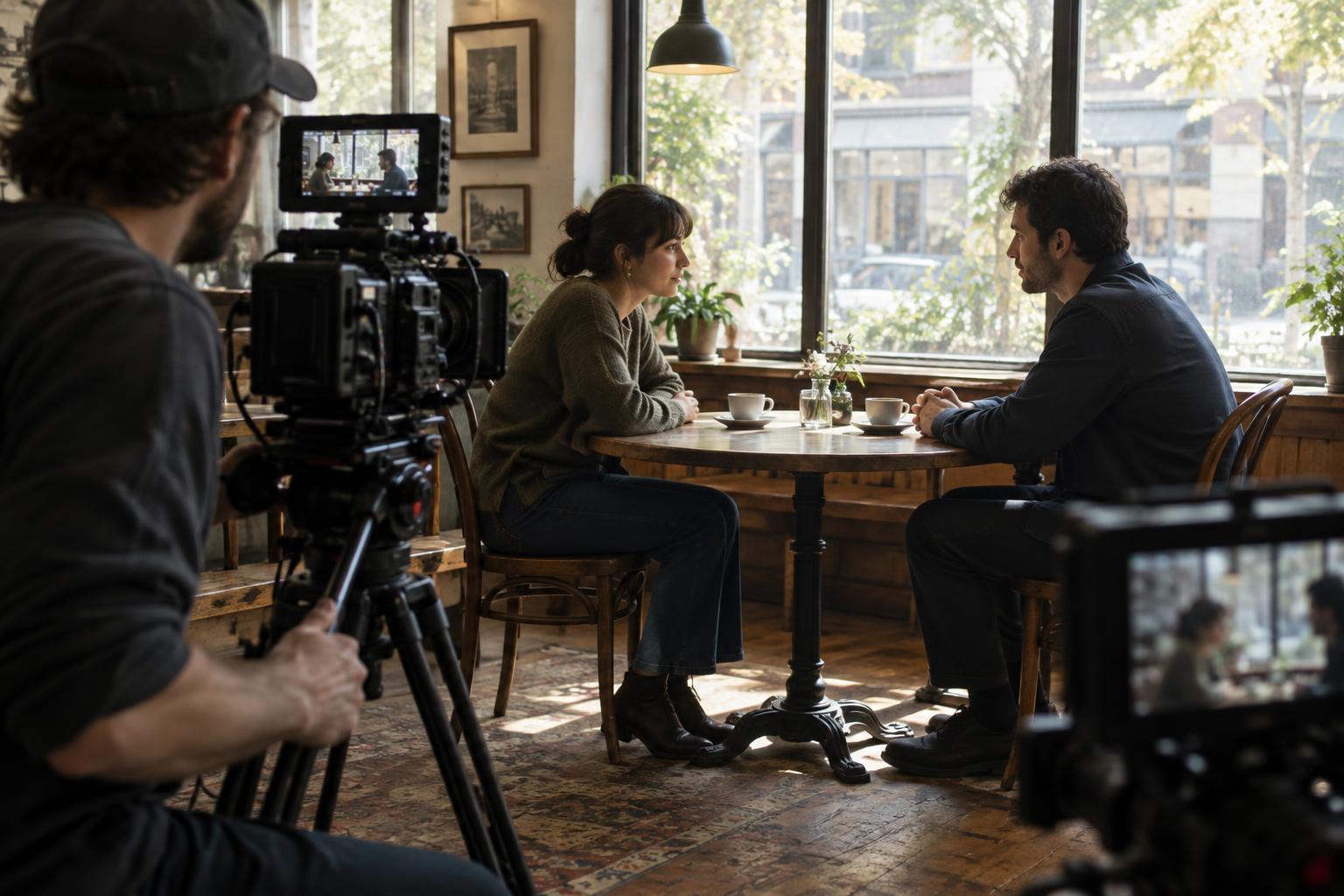
Imagine two people talking across a table. Draw an imaginary line between them: this is the axis of action. If the camera stays on one side of that line, one person will generally appear on the left of the frame and look right, while the other appears on the right and looks left. A cut between their close-ups preserves the impression that they face each other. The 180-degree rule is the practice of keeping the camera within that half-circle of possible positions.
The same principle applies to movement. If a cyclist travels from left to right in a wide shot, filming from the opposite side of the cyclist’s path can make the next shot appear to show travel from right to left. Nothing has changed in the fictional world, but the change in viewpoint may suggest a reversal. Consistent screen direction gives viewers one less spatial puzzle to solve, leaving them free to attend to the action.
Find the axis before choosing angles
For a simple conversation, the line connecting the speakers is a useful starting point. For a chase, it may follow the direction of travel. In a scene with several people, the most useful axis often comes from the relationship or action the audience needs to follow at that moment. Ask a practical question: which positions must remain clear when these shots are cut together?
Block the scene, then sketch a basic overhead view. Mark the performers, their movement and the camera positions you want for the wide shot and closer coverage. Check each proposed cut for consistent left-right placement and eyelines. This does not require exact geometry; it requires an understanding of what each frame will tell the viewer. During filming, a quick look at the previous shot can be more useful than relying on memory, especially if furniture or performers have shifted.
Why eyelines and movement matter together
Shot/reverse-shot coverage makes the rule easy to notice. If one character looks toward the right edge of their close-up, the other should usually look toward the left edge of theirs. The precise angle of the glance can also affect how directly they seem to engage. A mismatch may make both characters appear to look in the same direction, or make the space between them difficult to read.
The axis is less fixed when people move. Someone walking around a seated character may change the relationship that defined the original line. Rather than treating the first axis as permanent, watch for the point at which the audience can see a new spatial arrangement take shape. A wide shot can establish that arrangement before tighter shots depend on it. What matters is not obedience to a diagram but whether the sequence supplies enough visual information for each new cut to make sense.
Crossing the line without losing the viewer
A camera can cross the axis deliberately. Showing the crossing in a continuous camera move allows viewers to follow the change in perspective. An actor moving through the frame can also establish a new line of action. Another approach is to return to a wider view that clearly shows where everyone is, then begin coverage from the other side. Each method gives the audience a chance to update its mental map of the scene.
A head-on or otherwise neutral shot can sometimes bridge two sides because it emphasizes less left-right information. It is not a guaranteed fix, though: a sudden change in screen direction may still feel abrupt if the surrounding shots do not explain it. Test a proposed crossing in sequence rather than judging each shot alone. If the cut makes a viewer ask where someone went, the transition may need a clearer visual step.
Use clarity as a choice, not a constraint
Breaking the rule can be expressive. A sharp change in direction may make a confrontation feel unstable or mark a shift in power. That effect works best when the scene has first established a readable space, so the disruption feels purposeful rather than accidental. A quiet exchange might benefit from steady orientation; a moment of confusion might benefit from briefly unsettling it.
When planning or editing a scene, start by watching it without a diagram. Can you tell who faces whom, where a person is heading and what changes between shots? If the answers are clear, the camera language is doing its job, whether every angle follows the rule or not. The 180-degree rule is most valuable as a way to predict what a cut will communicate—and to choose when the viewer should feel grounded.