Find the scene’s turning point first
Before deciding where a scene starts, identify what changes in it. A character might learn a fact, lose an ally, make a choice or reveal a feeling they meant to hide. That change gives the editor a way to judge every moment around it. Does the opening prepare us to understand the turn? Does the ending let us register its consequence? A scene can be beautifully performed and still feel slow if it spends too long arriving at the event that matters.
Try describing the scene in two short phrases: what is true when it begins, and what is true when it ends. If both phrases say essentially the same thing, look for a smaller shift in power, knowledge or expectation. Once you can name the shift, review the footage without assuming that the scripted first and last lines must remain. Those lines may be useful, but they are options rather than fixed boundaries.
Enter at the moment that creates a useful question
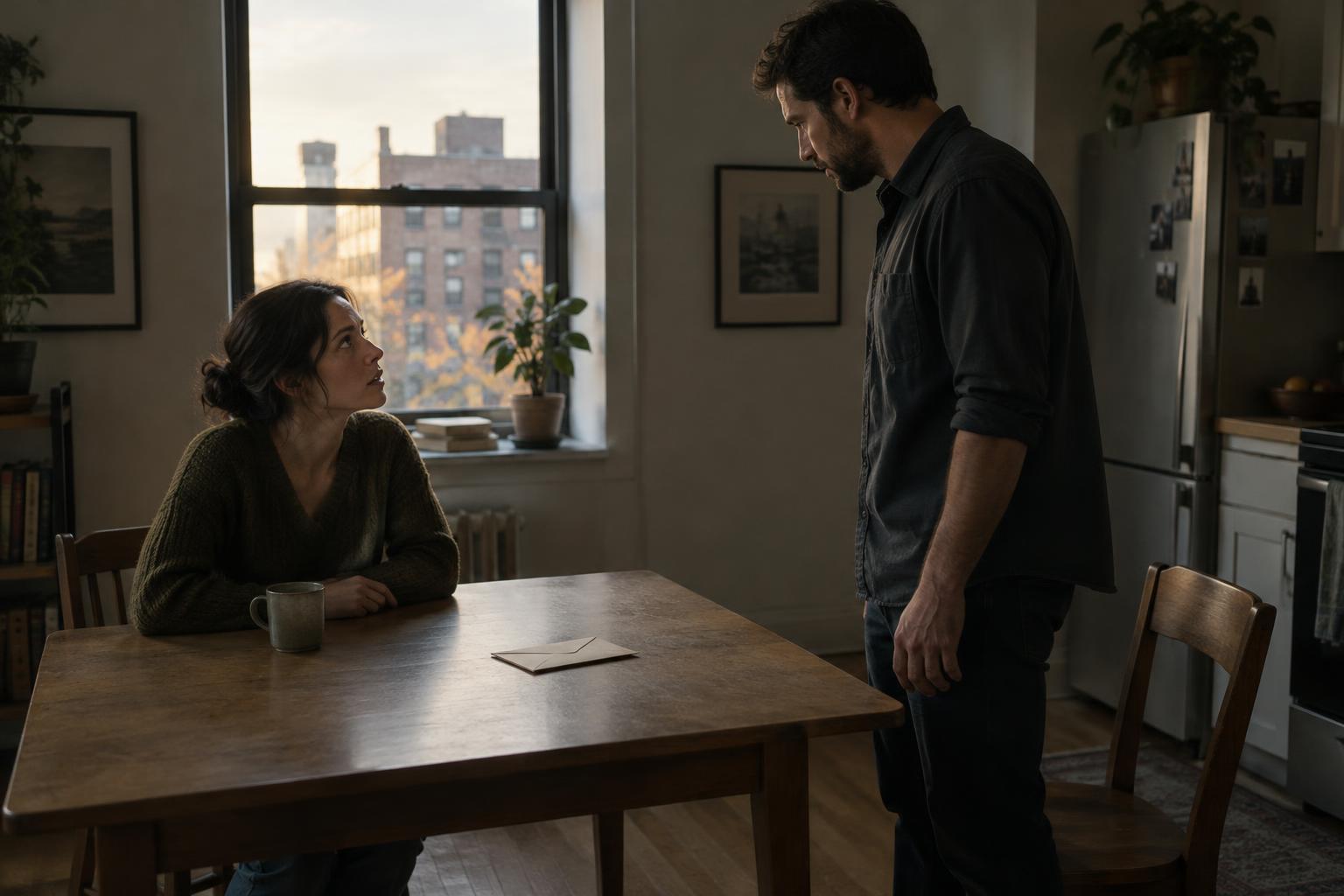
An opening needs enough context to orient the viewer, not necessarily every step that brought the characters into the room. Suppose two friends are about to discuss a broken promise. Starting with coats coming off and greetings may establish their ordinary routine. Starting with one friend noticing an unanswered message may create tension sooner. Neither choice is automatically better: the first can make the later conflict feel like an interruption, while the second asks the viewer to catch up as the conversation unfolds.
Test several entry points in the rough cut. Begin before the first line, on a revealing action, or after an exchange of pleasantries. Watch each version from the end of the previous scene rather than in isolation. If the preceding scene already tells us where the characters are going and why, another arrival may repeat information. If a location or relationship is unfamiliar, a brief orienting moment might help. An effective entrance gives viewers something to follow while leaving them able to understand what is at stake.
Leave after the turn, not necessarily after the explanation
Scenes often have a natural-looking tail: a character repeats the decision, everyone acknowledges it, and the room empties. That material can offer emotional breathing space, but it can also explain an impact the viewer has already felt. After the turning point, look for the first moment that makes its meaning clear. A held glance, a failed attempt to answer or an action that contradicts the spoken words may do more than a final summary line.
Cutting early should not become a rule of its own. Some scenes need time after the decisive moment so that a character’s response can become the real subject. Compare an exit on the revelation with an exit on the listener’s reaction. The first may send us forward with a question; the second may tell us how the revelation has changed a relationship. Choose according to what the next scene needs to inherit. A strong ending does not simply stop the action; it passes along an emotion, an expectation or an unresolved problem.
Use the transition to check the boundaries
The cut between scenes is a practical test of both scenes’ edges. Play the outgoing and incoming scenes together, then ask what the viewer knows at the cut and what they need to learn next. If the new scene begins by restating the previous scene’s conclusion, consider shortening one side. If the transition feels confusing, the answer may be a clearer opening image or sound rather than a longer explanation at the end of the earlier scene.
Sound can help shape this handoff without disguising a weak story choice. A sound from the next location heard just before the picture changes can prepare a new setting. Letting the final sound of one scene continue briefly over the next image can preserve its emotional weight. Try the transition both with and without that overlap: if the sound pulls attention away from the new scene, a clean break may be stronger.
For a final pass, watch several scenes in sequence and note where your attention rises or drifts. Trim one entrance or exit at a time, then replay the surrounding passage. The goal is not to make every scene as short as possible. It is to give each scene the time it needs to establish its change, and to leave when the story is ready to move.