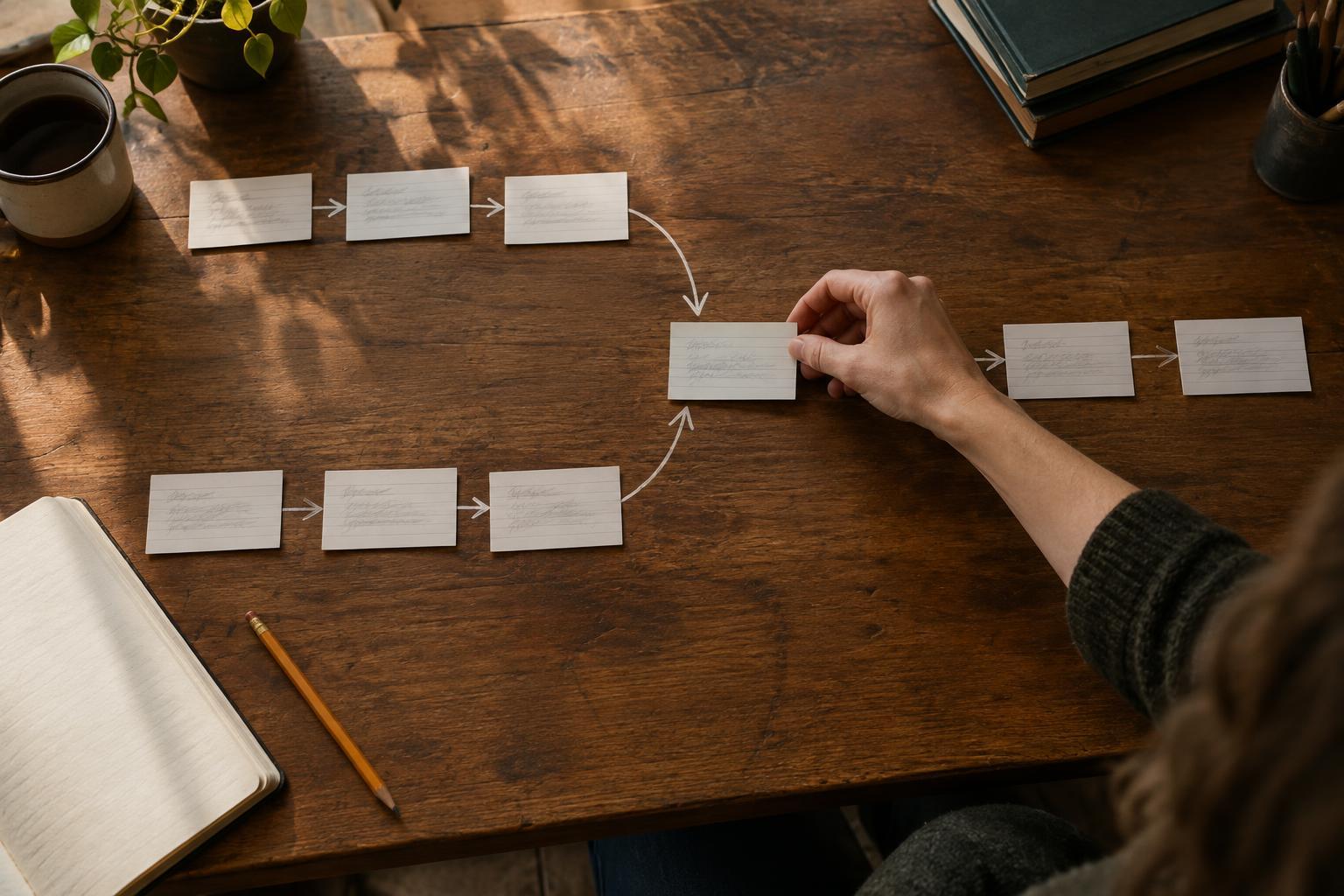
Think of the midpoint as a change in direction
The midpoint is often described as a major event near the center of a screenplay. Its position matters less than its effect. Before the turn, the protagonist pursues a goal with a particular understanding of the problem. Afterward, that understanding no longer holds. A discovery, victory, defeat, or choice forces a different approach. If the characters can continue with the same plan and the same expectations, the event may be exciting, but it has not changed the course of the plot.
Imagine a protagonist trying to recover a stolen object before it is sold. At the midpoint, they get it back—only to learn that it contains evidence implicating the person who hired them. The pursuit is over, but the central problem has grown more difficult. Keeping the object, returning it, or exposing its contents now carries a cost. The turn changes the protagonist’s immediate goal while keeping the story connected to what came before.
Build the turn from the protagonist’s current strategy
To design a midpoint, first write down what the protagonist is trying to do during the first half of the story. Be specific: “win the witness’s trust” is more useful than “solve the mystery.” Then ask what assumption makes that strategy seem sensible. Perhaps the protagonist believes the witness is frightened, the rival can be bargained with, or the family will stay safe if they keep a secret.
The midpoint can test that assumption. The witness may have been protecting the antagonist, the bargain may give the rival exactly what they wanted, or the secret may put the family in danger. This is stronger than adding a surprise unrelated to the protagonist’s actions. The new information grows out of their attempt to make progress, so the audience can see both why they made the choice and why it can no longer work.
A midpoint need not be a twist. The protagonist might achieve the very thing they have been seeking and find that success creates a harder obligation. They might also make a decision they have avoided since the opening scenes. In either case, the plot turns because action has consequences, not because the writer has introduced a new problem from nowhere.
Change the pressure, not just the volume
One way to make a midpoint feel bigger is to add danger: a deadline moves closer, an ally is captured, or a threat becomes public. Those developments can work, but escalating the scale alone may leave the story feeling repetitive. Consider changing the kind of pressure the protagonist faces. An external chase can become a question of whom to trust. A private ambition can demand a public sacrifice. A plan that depended on secrecy can become impossible once the truth is known.
The most useful turn often creates a new problem on two levels. It changes the practical task—what the protagonist must do next—and sharpens the personal conflict—what doing it will cost them. If a character who relies on control discovers that an ally acted independently to save them, the next step may require cooperation. Accepting that help also challenges the trait that shaped their earlier decisions. The plot and character arc can then move forward together.
Set up the turn so it feels surprising and earned
A midpoint should prompt the audience to reconsider earlier scenes without making those scenes seem dishonest. Plant the pieces that will matter: a rule the protagonist has not tested, a relationship with an unresolved tension, or a small consequence of their plan. These details need not announce the turn. They should give it a foundation the audience can recognize afterward.
Be careful not to rely on information withheld only for the sake of a reveal. If a character knows a fact that would govern their choices, hiding that fact from the audience may make the turn feel imposed. It is often more satisfying to let viewers understand the character’s reasoning, then reveal that the reasoning was incomplete. The audience experiences the change alongside the protagonist rather than waiting for the screenplay to explain itself.
Check what changes in the scenes that follow
The clearest test of a midpoint is the next sequence. Does the protagonist choose a new tactic? Has a relationship shifted enough to alter how characters speak or act together? Is there a consequence that cannot simply be undone? If the following scenes return to the old pursuit unchanged, the midpoint may need a more decisive outcome.
Try describing the story on either side of the turn in two sentences: “At first, the protagonist tries to…” and “After the midpoint, the protagonist must…” The second sentence should not merely add “but faster” or “against greater odds.” It should reveal a meaningful shift in knowledge, strategy, or commitment. A strong midpoint does not solve the story. It makes the familiar route forward unavailable, leaving the protagonist to take a more difficult one.